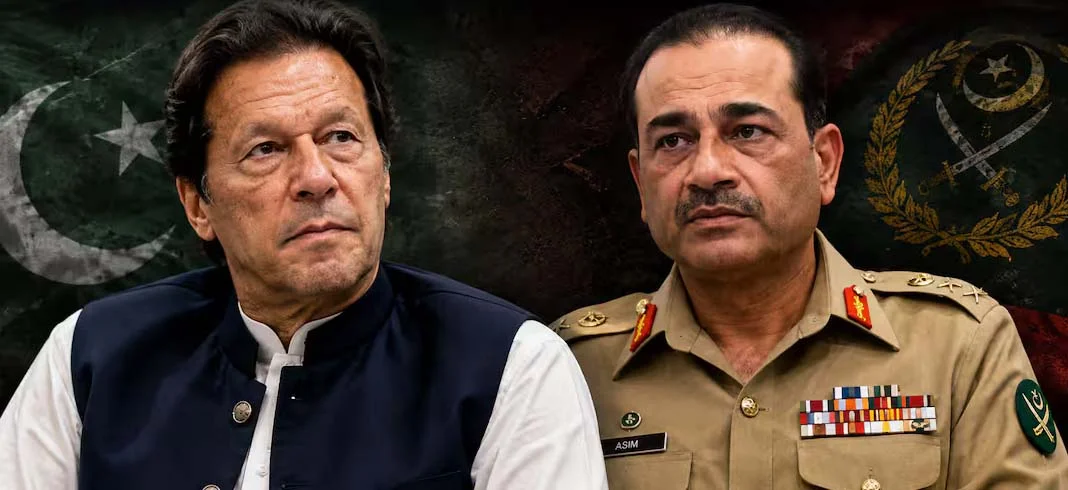
Lahore: A close aide to jailed former Pakistan Prime Minister Imran Khan has signalled that, should the PTI chief be released, he would steer clear of any direct confrontation with Pakistan’s military establishment and its chief, General Asim Munir.
Speaking to reporters, PTI spokesperson Zulfikar Bukhari said Imran Khan has always placed national interest above personal or political disputes.

“If Imran Khan were released tomorrow, he wouldn’t take any step that harms the country,” Bukhari said, ruling out any possibility of a direct clash with the military leadership. According to him, avoiding confrontation requires self-restraint. “You have to control your anger, suppress your pain, and endure it for the greater good of the country,” he added. Bukhari also suggested that the current military leadership has full authority to ease political tensions and release prisoners.
The remarks come on the heels of a Pakistan Supreme Court order directing authorities to shift the 73-year-old former prime minister from jail to a private hospital for better medical treatment. Political analysts are viewing this as a significant turning point in easing months of sharp tension between the two sides.
Since being removed from power through a no-confidence vote in 2022 and his subsequent arrest in 2023, Imran Khan and his supporters had taken an increasingly combative stance against the military establishment. While analysts remain unsure whether Khan himself fully endorses Bukhari’s conciliatory tone, the spokesperson’s comments clearly suggest that PTI is looking for a practical way to end the prolonged standoff with the government and the army.
Why Might Imran Khan Be Softening His Stance Toward General Asim Munir?
A Survival Strategy Under Legal and Institutional Pressure
Amid dozens of legal cases, continued detention, and a broad crackdown on party workers following the violence of May 9, 2023, Imran Khan’s apparent willingness to talk appears to be a calculated move — not surrender, but an effort to preserve the party’s political survival and de-escalate the standoff.
The Reality of Pakistan’s Political Structure
Historically, civilian leaders in Pakistan have had to accept that long-term political stability and effective governance require a working relationship with the military. Opening the door to dialogue reflects an acceptance of this practical political reality.
A “Country First” Approach
According to PTI, Imran Khan is now prioritising the country’s broader interests. With the economy already under severe strain, a direct confrontation with the military could further destabilise the country internally — something the party wants to avoid.
Relief for Party Workers and Leaders
PTI’s organisational structure has been under immense pressure due to repeated arrests and ongoing legal cases. By softening its tone toward the army chief, the party hopes to ease the administrative pressure on its workers, allied leaders, and Imran Khan himself.

Paving the Way for Backchannel Talks
The primary goal behind the softer public rhetoric appears to be keeping the door open for behind-the-scenes talks with the military leadership — talks that could eventually pave the way for Khan’s release and fair political participation.
The Institutionalisation of Economic Governance (SIFC)
With the formation of the Special Investment Facilitation Council (SIFC), General Asim Munir’s role has expanded well beyond national security to include economic policy and foreign investment decisions, effectively giving him authority on par with the prime minister.
Direct Action Against Smuggling and Illegal Trade
The military has directly led nationwide crackdowns on currency speculation, illegal cross-border trade, and smuggling — moves that have had a direct impact on macroeconomic stability and given the army chief unprecedented influence over domestic governance.
Institutional Continuity Beyond Electoral Cycles
While civilian governments and prime ministers must contend with electoral cycles, shifting political alliances, and constantly changing equations, the military structure remains stable. This institutional continuity gives the army chief significant power to shape long-term policy and play a decisive role in national decision-making.
A Central Role in Foreign Policy and Strategic Diplomacy
The army chief plays a key role in managing Pakistan’s strategic relationships — including with China (via CPEC), the United States, Saudi Arabia, and the UAE. His frequent presence in foreign visits and negotiations for financial assistance and strategic agreements has made the position highly influential on the international stage as well.
Firm Control Over Internal Security and Intelligence
The army chief maintains direct control over the country’s internal security situation, counter-terrorism operations, and the state’s intelligence apparatus (ISI).